


Chairperson Frumin and members of the committee, and committee staff, thank you for the opportunity to testify. My name is Shira Markoff, and I am the Director of Economic Policy at the DC Fiscal Policy Institute (DCFPI). DCFPI is a non-profit organization that shapes racially-just tax, budget, and policy decisions by centering Black and brown communities in our research and analysis, community partnerships, and advocacy efforts to advance an antiracist, equitable future.
The Office of the Deputy Mayor for Planning and Economic Development (DMPED) plays a key role in developing and implementing economic growth strategies for the District—a role that has taken on extra importance in the last year as DC has navigated a changing economy because of federal actions. To shepherd DC through these tough economic times and drive inclusive growth, DMPED’s strategy should focus on shoring up the financial wellbeing of the workers who power DC’s economy. Instead, DMPED continues to direct much of its resources and attention to the corporate elite using disproven trickle-down strategies.
DC is facing significant spending pressures over the next few years, with revenues expected to grow more slowly due to cuts in the federal workforce while the costs of many programs will increase because of inflationary pressures and growing human needs. Mayor Bowser and the DC Council talk about the need to rein in spending, and they have focused on the cost of income support programs, which are more needed than ever during this difficult economic climate. Yet we are not hearing many questions about DMPED’s budget and whether that spending is creating the type of inclusive economic growth DC needs to alleviate poverty, grow the middle class, and address racial disparities.
In my testimony, I will focus on the need for more oversight of DMPED’s economic development strategy and evaluation of its programs to ensure that District resources are being maximized to promote inclusive economic growth. Specifically, I will discuss:
- Why addressing inequality in DC, especially racial disparities, is an essential component to promoting sustainable economic growth;
- How DMPED lacks a coherent strategy to address racial inequities and is not being held accountable for meeting established racial equity goals;
- Why the Council needs to scrutinize the return on investment for DMPED’s initiatives; and
- How the Council should hold DMPED accountable for promoting inclusive economic growth.
High Economic Inequality is a Drag on DC’s Economy
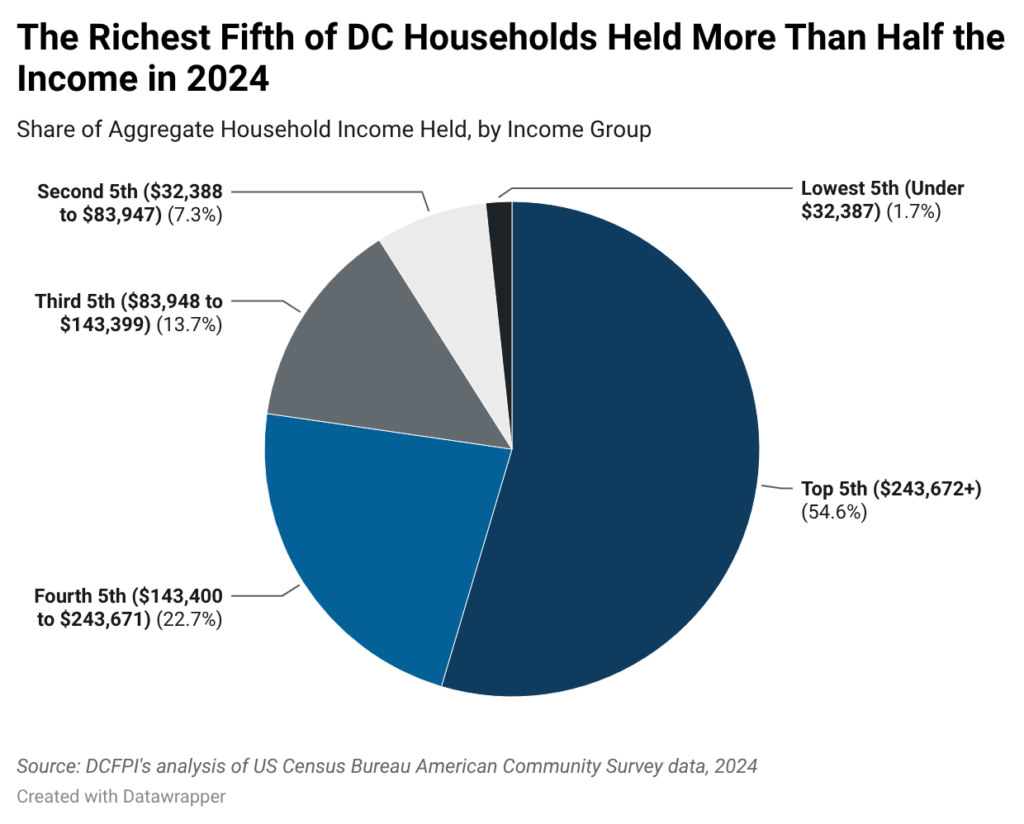
High inequality is not only a matter of unfairness. It hampers economic growth and mobility. This means that the highly uneven distribution of income and wealth in DC is a drag on the economy.[1],[2] Several indicators show that DC is highly unequal. The Gini coefficient for DC—a measure of income inequality where zero means perfect equality (everyone has the same) and one means total inequality (one person has everything)—was .52 in 2024. This figure is statistically tied with Puerto Rico and New York for the highest in the nation.[3] The top fifth of earners in the District receive nearly 55 percent of aggregate household income, while the lowest fifth of earners receive less than 2 percent of aggregate income (Figure 1).[4] In fact, the top 5 percent of earners in DC receive a larger share of aggregate income than the bottom 60 percent of earners combined.[5]
Figure 1
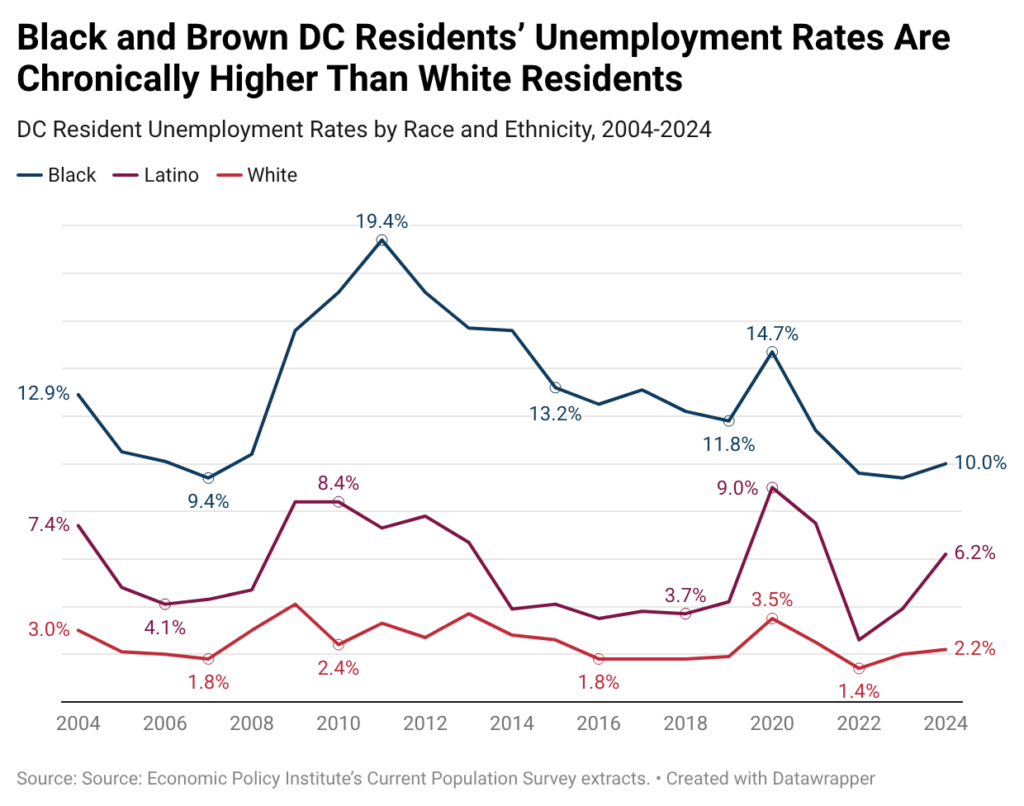
Much of the economic inequality in DC is driven by racial and ethnic disparities stemming from the long history of racism in policies and systems that denied Black, and later non-Black people of color, in DC equal access to quality education, jobs, and wealth-building opportunities. Black and Latino residents have worse economic outcomes than white residents by every economic measure, both during good and bad economic times. For example, the median hourly wage for white DC workers in 2024 was about 1.8 times higher than that of Black and Latino workers.[6] Employment is also less secure for Black and Latino District workers than white workers. Between 2004 and 2024, average unemployment for Black workers ranged from 9.4 percent to 19.4 percent and average unemployment for Latino workers ranged from 2.6 percent to 9 percent. By comparison, white unemployment was as low as 1.4 percent and never higher than 4.1 percent (Figure 2).[7]
Figure 2
DMPED Lacks a Plan for Meaningfully Addressing Racial Inequity
Mayor Bowser and DMPED acknowledged DC’s deep racial disparities and how they hamper both individual economic mobility and overall economic growth in the 2023-2027 economic development strategy, known as the Comeback Plan. The plan laid out three sets of economic goals for DC: fostering successful businesses, creating opportunity-rich neighborhoods, and supporting thriving people.[8] Over the past few years, however, the focus on thriving people has fallen by the wayside, while the mayor and DMPED have doubled down on business attraction. The economic growth agenda that Mayor Bowser and DMPED put forth in the spring of 2025 concentrated solely on businesses and downtown investments, not on workers or addressing racial disparities.[9]
The Comeback Plan set a goal of increasing the median household income for Black residents by $25,000 to $78,000 by 2028 (from nearly $53,000 in 2021).[10] However, since then, DMPED has been quiet about this goal and has not publicly announced a plan to reach it. The median income for Black DC households was $59,285 in 2024 according to the American Community Survey. This amount is not statistically different from the median household income in 2021, meaning that Black household income was essentially stagnant in the initial three-year period of this goal.
The only DMPED program directly addressing household income is the Strong Families, Strong Futures (SFSF) guaranteed income pilot. However, the scale of the program—serving only around 130 people—is not sufficient to change the median income of Black households, and the mayor and DMPED have not expressed any plans to expand it beyond FY 2026.[11] At the same time, some of Mayor Bowser’s recent actions run counter to increasing Black median household income. For example, her FY 2026 budget proposal eliminated the Child Tax Credit, which would have put money into the pockets of low- and moderate-income families who are disproportionately Black because of systemic racism.
Another area where more information is needed on DMPED’s efforts to address racial inequities is on Black homeownership. The mayor and DMPED launched the Black Homeownership Strike Force to much fanfare in 2022, and the group released its recommendations several months later.[12] In response to pre-hearing questions for the 2025 performance oversight hearing, DMPED stated that it would advance the recommendations of the task force in FY 2025.[13] However, DMPED has not provided updated information on these efforts either on its website or in responses to the 2026 performance oversight pre-hearing questions.
The committee asked DMPED to detail opportunities to address racial inequities in the questions sent in advance of this hearing, but DMPED’s responses do not provide sufficient information to assess if their initiatives have the potential for advancing racial equity. For example, one of the opportunities DMPED lists is stabilizing DC’s retailers and restaurants. DMPED states that it has “deployed more than $50M over the past 10 years to support local retailers and restaurants, with a geographic focus on under-amenitized and under-resourced communities in Wards 5, 7 and 8,” and that its focus for FY 2026 is protecting local entrepreneurs and DC’s grants and investments now that consumer spending is down. This statement lacks specificity about how DMPED is addressing racial disparities. First, it does not specify what percentage of the $50 million went to businesses in Wards 5, 7, and 8, and second, it does not state what percentage of the grants within those wards went specifically to Black or brown entrepreneurs. In addition, DMPED does not explain how it plans to specifically support Black and brown-owned businesses, a key pathway to growing a diverse middle class.[14]
Some of the oversight hearing responses also raise concern about the office’s perception of what will move the needle on racial inequities. For example, DMPED cited the RENTAL Act that it pushed the Council to pass in 2025 as one of the office’s greatest opportunities to address racial inequity.[15] The Council Office of Racial Equity’s assessment of the legislation found that it contained several provisions that will likely have negative impacts on racial equity.[16]
DC Council Should More Closely Examine the Return on Investment for DMPED’s Initiatives
DC is facing spending pressures over the next few years, and the mayor has honed in on income support programs as a place for cuts, such as at her breakfast meeting with the DC Council last week. However, despite the tight budget, we are not seeing a similar examination of DMPED’s budget.
DMPED has a significant amount of flexibility in managing its budget, which included $50 million in operating funds and $333 million in the capital budget for FY 2026. DMPED also administers millions of dollars in tax abatements on programs such as Housing in Downtown, which will rise in cost to $41 million in FY 2028 and receive an automatic annual adjustment of 4 percent each year thereafter.[17] The DC Auditor found that DMPED exceeded its Council-approved budget in 13 out of 20 years examined, including spending more than double the approved budget in FY 2024.[18] Each grant DMPED distributes to businesses or tax break it authorizes for developers is a deliberate choice of how to invest the District’s limited resources, so the return on investment the District is receiving from these investments bears closer scrutiny.
DMPED continues to invest heavily in disproven trickle-down strategies that divert millions in tax expenditures to attract businesses or spur business activities that typically don’t result in better outcomes for residents and may exacerbate racial disparities.[19] For example, DMPED’s focus on increasing the sports and entertainment industries in DC—including the biggest ticket item, RFK stadium—is likely to result in more permanent low-wage jobs once construction concludes. These jobs, such as food service, cashiers, security, and janitors, typically pay low wages that would not be enough to afford the cost of living in DC and therefore not decrease the need for income supports, like child care subsidies and housing assistance, to fill the gap.[20] DMPED is potentially seeding higher paying tech sector jobs through initiatives such as the DC Venture Capital Fund, but the pathway for workers in low-wage jobs to access higher-paying jobs is unclear. Without an intentional strategy between DMPED, the Department of Employment Services (DOES), and the Department of Human Services (DHS) for connecting residents with low- and moderate-incomes to these jobs, the jobs are likely to go to people who already have higher incomes or are coming from outside DC.
Through the responses to the performance oversight pre-hearing questions, DMPED provided information on outputs for key programs like the Vitality Fund and the DC Venture Capital Fund. So we know, for example, how many businesses have received grants through the Vitality Fund and the projected number of jobs they will create. However, we don’t know what the results have been for past Vitality Fund grantees. For example, are employers meeting program requirements such as complying with First Source for awards exceeding $300,000? Have the jobs that grantees estimated in their applications been created and maintained? If so, how many of those jobs went to District residents, and what were the demographic characteristics (e.g., race, income, residency) of those who filled the jobs? Without a deeper assessment of DMPED’s programs beyond the outputs reported and estimates of impacts from grantees’ applications, we are unable to determine the return the District is getting on these investments and whether DC is making the right investments to spur inclusive economic growth.
The Council Needs to Conduct Oversight to Ensure DMPED’s Initiatives Promote Inclusive Economic Growth
Mayor Bowser has asserted that the way for DC to raise more revenue to cover the costs of income and work supports for people with low incomes is through enacting her growth agenda.[21] But without research to back up these economic strategies or evaluations to show that the programs are working, the mayor and DMPED are essentially asking the Council and DC residents to take a leap of faith that this costly agenda will spur economic activity and fill revenue holes in future years.[22] If that growth doesn’t materialize, DC’s lowest-income residents—who are disproportionately Black and brown due to systemic racism—will suffer the most harm, after already bearing the brunt of cuts in FY 2026.
Because of the importance of the outcomes of DMPED’s initiatives for the District, the Council should more closely scrutinize DMPED’s initiatives. Specifically, the Council should:
- Conduct robust oversight of DMPED programs and require the Office of Chief Financial Officer (OCFO) to evaluate their efficacy, including their impact on racial inequities.
- Request an update from DMPED on how it plans to make progress toward all goals set out in the Comeback Plan—including increasing the Black household median income—and what, if any, changes it has made to the plan due to changing economic conditions in DC.
- Ask DMPED to provide more specific information on the racial equity impacts of all its initiatives (for both grant programs and tax abatements) including a breakdown of who is benefiting from the initiative by race, ward, and amount of money.
- Require more frequent, comprehensive economic development tax expenditure reviews by the OCFO and hold at least one standalone hearing per Council period assessing DC’s incentives and whether they are still needed as economic conditions change.[23]
- Ask for more information from DMPED on how it is working with DOES and DHS to create a pipeline for residents experiencing poverty and those with low- and moderate-incomes to access higher-paying created through DMPED’s initiatives.
I urge the committee to take these actions to help ensure that our economic development resources are being used to make the District a place in which everyone can thrive. Thank you for the opportunity to testify today. I am happy to take questions.
- Josh Bivens and Asha Banerjee, “Inequality’s drag on aggregate demand,” Economic Policy Institute, May 24, 2022.
- Erica Williams, “DC’s Extreme Wealth Concentration Exacerbates Racial Inequality, Limits Economic Opportunity,” DC Fiscal Policy Institute, October 20, 2022.
- DCFPI analysis of US Census Bureau, American Community Survey, “Gini Index of Income Inequality,” 2024.
- US Census Bureau, American Community Survey, “Shares of Aggregate Income by Quintiles” 2024. The top fifth of earners (also known as the top quintile) refers to people who have incomes in the top 20 percent of incomes in DC, i.e., higher than 80 percent of earners. The lowest fifth of earners (also known as the bottom quintile) refers to people who have incomes in the bottom 20 percent of earners in DC, i.e., lower than 80 percent of earners.
- Ibid.
- DCFPI analysis of Economic Policy Institute, State of Working America Data Library, “Median real hourly wage (2024$),” 2025.
- Economic Policy Institute, State of Working America Data Library, “Unemployment rate,” 2025.
- DC Office of the Deputy Mayor for Planning and Economic Development, “DC’s Comeback Plan: Our 2023-2027 Economic Development Strategy,” January 2023.
- Executive Office of the Mayor, “A Transformational Growth Agenda for a Stronger DC,” May 2025.
- DMPED, DC’s Comeback Plan, 2023.
- Martha’s Table, “Strong Families, Strong Futures,” accessed February 11, 2026.
- Executive Office of the Mayor, “Mayor Bowser Launches Black Homeownership Strike Force to Combat Racial Wealth Gap,” June 9, 2022.
- Office of the Deputy Mayor for Planning and Economic Development, “Committee on Business & Economic Development Performance Oversight Pre-Hearing Questions,” Submitted to DC Council Committee on Business and Economic Development, 2025, p. 2.
- Office of the Deputy Mayor for Planning and Economic Development, “Supplemental Performance Oversight Questions – Office of the Deputy Mayor for Planning and Economic Development,” Submitted to DC Council Committee on Human Services, 2026, p. 2.
- Ibid.
- Council Office of Racial Equity, “Racial Equity Impact Assessment: Rebalancing Expectations for Neighbors, Tenants, and Landlords (RENTAL) Act of 2025,” July 14, 2025. ?
- In contrast, the budget is scheduled to end automatic annual adjustments to cash assistance to families with poverty-level incomes in the Temporary Assistance for Need Families in FY 2027.
- Office of the DC Auditor, “Twenty Years of D.C. Agency Overspending,” November 20, 2025, p. 14. ?
- Tazra Mitchell and Shira Markoff, “Mayor’s Economic Playbook Full of Disproven Ideas that Could Worsen Inequality,” DC Fiscal Policy Institute, May 12, 2025.
- On average, from 2021-2025, the median wage in DC was $17.75/hour for food preparation workers, $17/hour for janitors, $15.45/hour for cashiers, and $19.50 for security workers. DCFPI analysis of Economic Policy Institute’s Current Population Survey Extracts, Version 2026.2.12. Overall, the leisure and hospitality industry has the highest percentage of low-wage workers of any industry in the US. In 2025, 61 percent of workers in this industry nationally were paid less than $20/hour. Economic Policy Institute, “Low Wage Workforce Tracker,” January 2026.
- Meagan Flynn and Jenny Gathright, “Bowser bets on business-friendly D.C. budget while cutting some programs,” The Washington Post, May 28, 2025.
- Shira Markoff, “Double Standard of Evidence for Economic Development Incentives Comes at the Expense of Residents’ Wellbeing and a Stronger Economy,” DC Fiscal Policy Institute, July 14, 2025.
- For a good example of a DC government tax expenditure analysis, see: Office of Revenue Analysis, “Review of Economic Development Tax Expenditures,” Office of Chief Financial Officer, November 2018.