


This November, the DC Council significantly increased economic security for approximately 78,000 children and their families through legislation that restores the District’s Child Tax Credit (CTC) and strengthens the DC Earned Income Tax Credit (EITC). The two credits are highly effective, proven tools for reducing child poverty with long-term benefits over children’s life cycle and for the economy broadly.
Child poverty in the District is higher than the national average and racial disparities are stark. Nearly 1 in 2 Black children in DC lives in a family with income below the poverty line, while virtually no white children do, according to DC Fiscal Policy Institute’s analysis of US Census data. By putting more money directly into the pockets of individuals and families with low and moderate incomes, these credits will improve child well-being and provide critical financial support at a time when many DC families are struggling.
 The new credits were made possible thanks to the Council’s decision to “unlink” from federal tax changes. Through emergency legislation, the Council unlinked DC’s tax code from harmful cuts in the One Big Beautiful Bill Act that would have primarily benefited wealthy households and corporations. This move preserved nearly $700 million in revenue over five years, which allowed the Council to invest in families and workers through an amendment to the bill that restores and expands DC’s CTC and accelerates an already planned full local match of the federal EITC.
Because these investments were made via temporary legislation, the mayor and DC Council must take further action to make them permanent. In addition, lawmakers will need to reverse scheduled cuts to other economic security programs to realize the full benefit of the credits.
Restored CTC Provides Up to $1,000 Per Child
The CTC provides direct financial support to low- and moderate-income families with children, helping households cover essential expenses like housing, food, and child care.
Efforts to establish a local CTC in DC date back several years. Councilmember Parker previously championed legislation to create the credit through the Child Tax Credit Amendment Act of 2024, which passed and was slated for implementation this tax year. Under that law, families would have received up to $420 per child under age six, capped at three children per family. However, Mayor Bowser repealed the credit in her fiscal year (FY) 2026 budget before it ever took effect.
The emergency legislation not only restores DC’s local CTC but also makes it significantly stronger. Effective tax year 2026, the new credit provides up to $1,000 per dependent child under age 18 and is fully refundable, meaning families can receive the full amount even if they have little or no income tax. Unlike the previous CTC, the credit has no family cap, offering more generous support for families across the District.
Expanded EITC Matches 100 Percent of Federal Credit
The EITC provides financial relief to low- and moderate-income workers, helping individuals keep more of what they earn and reducing their income tax liability.
DC’s local EITC—established in 2000—works by “matching” a portion of the federal EITC. For example, in tax year 2024, a family that qualified for a $3,000 federal EITC received a DC match rate of 70 percent, or an additional $2,100 from the District.
Lawmakers scheduled the local EITC to rise to 85 percent of the federal credit for tax years 2025 to 2028, before reaching full parity with the federal EITC in 2029. The emergency legislation accelerates the full match to tax year 2025, jumping directly to 100 percent immediately, making DC’s EITC the most generous in the nation.
New Credits Will Reduce Child Poverty and Narrow Racial Inequities
Together, these credits offer financial relief to families who need it most, including a disproportionate share of Black families, who are overrepresented among low-income households due to systemic racism, historical and ongoing discrimination, and barriers to opportunity.
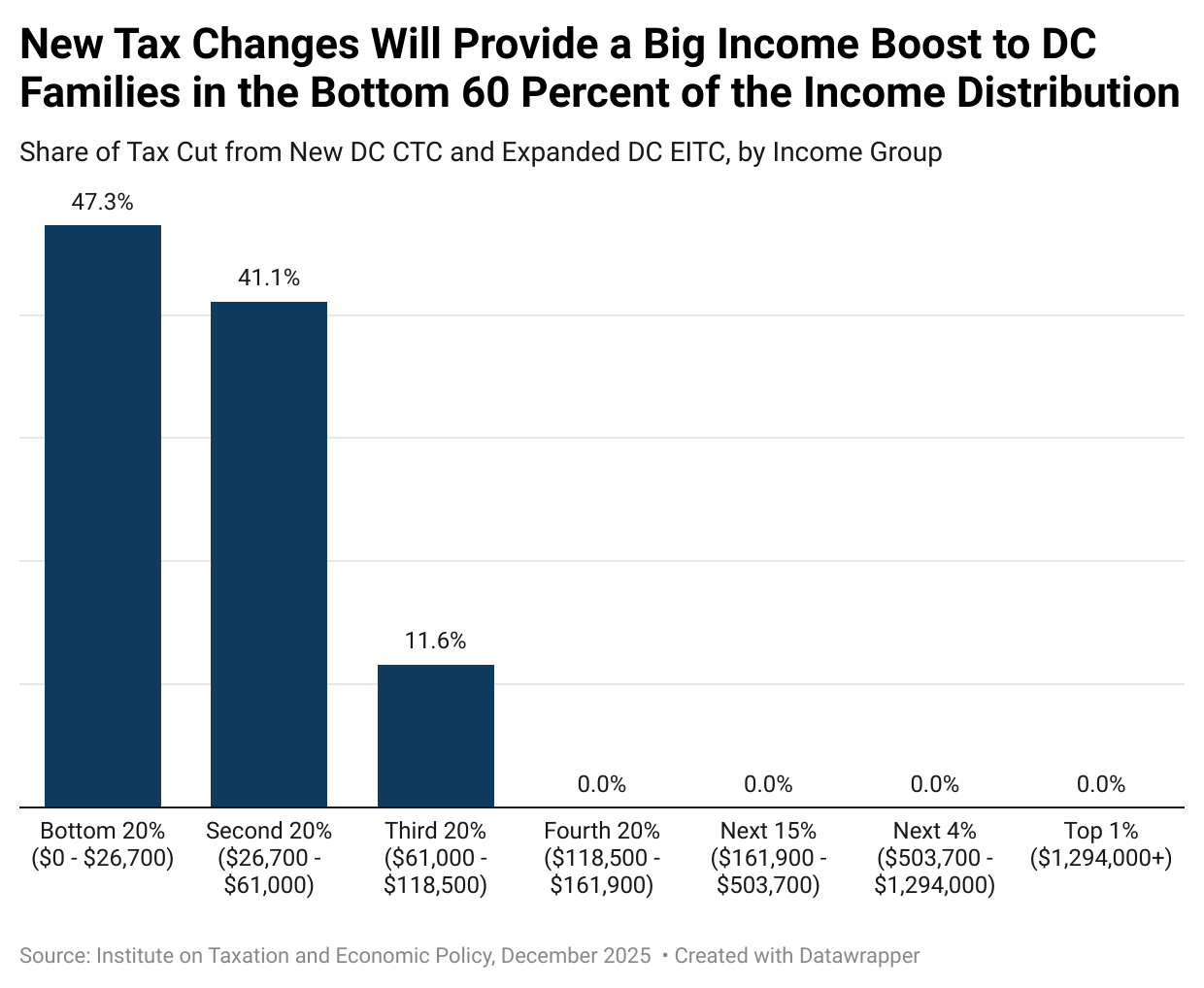
Nearly 78,000 kids are expected to benefit from these credits, according to analysis from the Institute on Taxation and Economic Policy. Most of the gains will go to households earning less than $61,000 (Figure 1). Households earning under about $27,000 will receive the most support, with an average tax cut of $1,659. To put this figure in perspective, that amount could cover nearly one month of rent or about two months of food for a single parent with two kids. This support is especially important for Black families, whose median household income ($60,591) is just over one-third of that of white, non-Hispanic households ($168,800).
The combined effect of the new CTC and expanded EITC is projected to reduce child poverty in the District by 20 percent, using the Supplemental Poverty Measure, according to unpublished analyses for DCFPI from Columbia University’s Center on Poverty and Social Policy.
DC Lawmakers Must Protect These Transformative Investments in the FY 2027 Budget
The District’s restored CTC and expanded EITC come at a crucial moment, as residents face rising costs and both federal and local cuts to health care, food assistance, and other essential supports. With some of the most expansive local tax credits in the nation for low- and moderate-income families, DC is now leading the charge to protect children in an increasingly hostile economic environment.
But the benefits of these advances could be undermined by cuts to other programs, particularly Temporary Assistance for Needy Families cash benefits beginning in FY 2027. The mayor and DC Council must reverse these and other cuts to ensure families can better weather the local economic downturn. Additionally, because DC lawmakers approved these credits through emergency and temporary legislation, they must be permanently enshrined in the budget next year. The endurance of these credits is essential to delivering lasting reductions in child poverty, advancing racial equity across the District, and building a more inclusive economy.
