


DC has the highest child care costs in the nation: For the District’s lowest income residents, who due to systemic racism are disproportionately Black and brown, child care can cost up to 32 percent of their annual pay. The child care subsidy program helps families with low and moderate incomes afford this expense. DC lawmakers underfunded this program, which is now facing a dire budget shortfall in fiscal year (FY) 2026. To curb costs, Mayor Bowser has proposed cutting reimbursement rates to child development facilities (CDFs), even though current rates already do not reflect the true cost of care. Doing so would make it harder for these small businesses to operate and stay in the program and disincentive new CDFs from participating in the program, reducing the program’s reach and effectiveness.
This misguided approach to balancing the budget would also reduce opportunities for parents to go to work or school and for children to jumpstart their education in a safe and supportive environment, harming DC’s economy. DC lawmakers should instead invest more deeply in the child care subsidy program so providers can be paid fully for the care they provide and more families can have access to affordable, high-quality child care.
Current Reimbursement Rates Do Not Reflect the True Cost of Care
Reimbursement rates—or the monetary value of child care vouchers—vary based on the child’s age, whether they attend a facility part- or full-time, the type of facility (center or home), and the facility’s quality rating. Since the adoption of the Birth-to-Three for All DC Act in 2018, the Office of the State Superintendent of Education (OSSE) must model the true cost of care every three years to determine reimbursement rates.
The True Cost of Care model considers the variety of cost drivers in a child care center or home. These include educators’ wages and benefits—the primary cost driver—as well as adult-to-child ratios, the cost of supplies and supplemental services, and other expenses associated with licensing and compliance with local and federal laws. In general, it costs more to operate a center versus a home-based program and, in either setting, to serve infants and toddlers versus older children primarily due to lower adult-to-child ratios.
OSSE has completed five cost modeling studies since 2016 and raised reimbursement rates to reflect increasing costs. However, reimbursement rates still lag the true cost of care except for the rate paid to child care homes serving infants and toddlers. In all other age, setting, and quality rating categories, reimbursement rates are 14 to 45 percent below the true cost of care (Figure 1).
Figure 1.
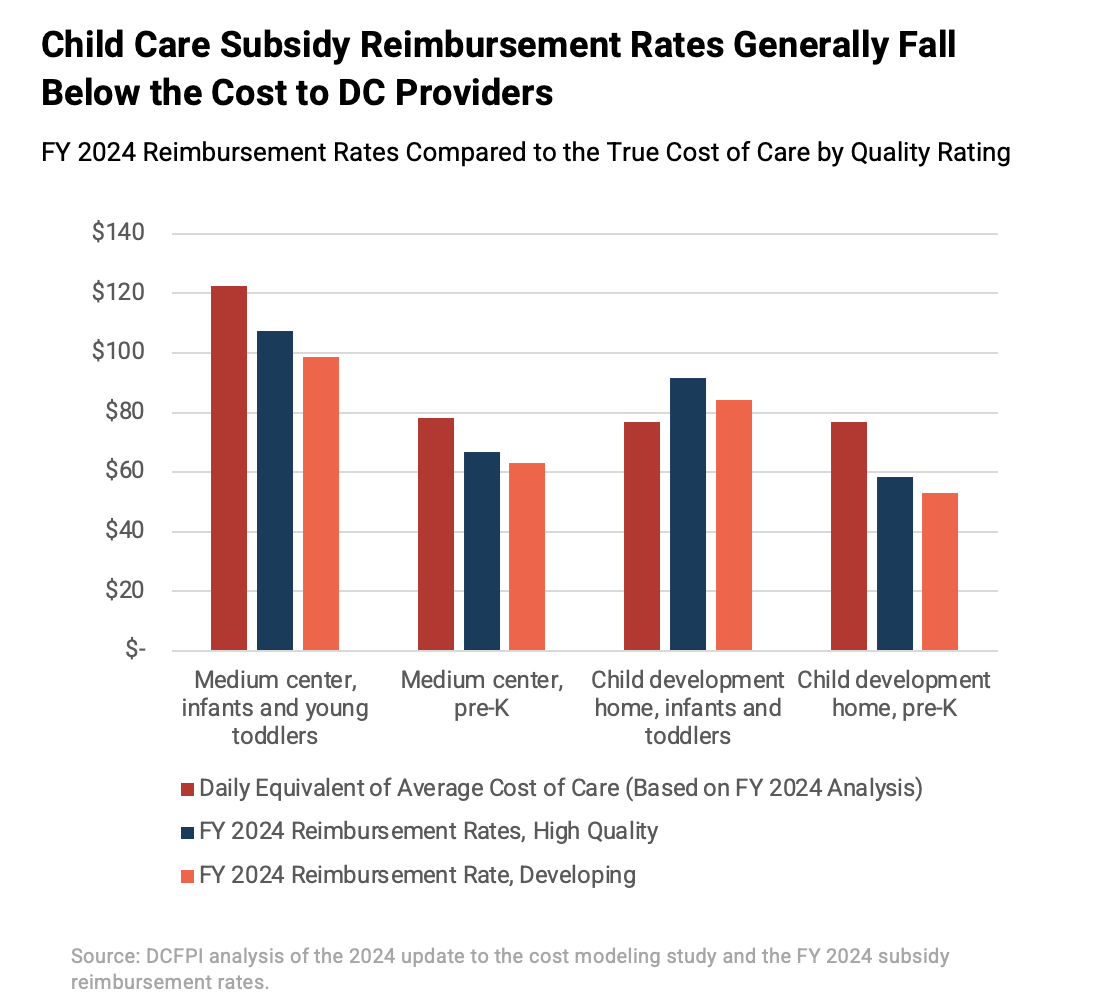
Since OSSE raised reimbursement rates in 2023, lawmakers have cut the subsidy budget, so OSSE has kept reimbursement rates flat despite the increasing operational costs to facilities and inflation.
Cutting Reimbursement Rates Will Make Finding and Paying for Child Care Harder
Just over half of CDFs in the District currently participate in the subsidy program, with nearly all serving a mix of subsidy-enrolled and private-pay families. By reducing reimbursement rates, existing subsidy providers will struggle to keep up with the growing operating costs and may need to close classrooms or raise tuition for private-pay families to prevent closures. This may cause some CDFs to stop accepting child care subsidies and further disincentive non-subsidy providers from participating. CDF directors surveyed by the DC Fiscal Policy Institute identified reimbursement rates as a primary reason for not participating in the subsidy program.
Fewer classrooms and CDF closures will shrink supply, which DC cannot afford because demand for child care already outpaces supply. DC has made progress in closing the supply gap for infant-toddler seats. In FY 2024, there were enough infant and toddler seats to serve about 58 percent of families, up from 46 Despite this progress, infant and toddler care remains prohibitively expensive for many DC families. Cutting reimbursement rates will exacerbate this problem because it reduces the funding the government contributes towards care and shifts that cost to CDFs and, ultimately, families, causing tuition to increase.
District lawmakers need to commit to fully funding the child care subsidy program and strive towards reimbursing subsidy providers based on the true cost of care. Investing fully in the child care subsidy program will help providers serve more families and make it easier for families to stay and thrive in the District.
Sources: DC Fiscal Policy Institute, “If You Build It: Recommendations for Increasing the Supply of Affordable Child Care to Meet District Demand,” February 19, 2025. And, author’s analysis of DC Kids Count data, February 2025.
