


Testimony delivered on February 26, 2026
Chairperson Frumin and members of the committee, thank you for the opportunity to testify. My name is Maria Manansala, and I am a Policy Fellow at the DC Fiscal Policy Institute (DCFPI). DCFPI shapes racially-just tax, budget, and policy decisions by centering Black and brown communities in our research and analysis, community partnerships, and advocacy efforts to advance an antiracist, equitable future. I also co-chair the TANF is Still a Lifeline Coalition, a group of advocates working to support families with children by fighting to preserve and bolster DC’s Temporary Assistance for Needy Families (TANF) program.
Despite TANF’s proven role in reducing family hardship and supporting child well-being, DC lawmakers approved major cuts to the program that will reduce or freeze cash benefits for more than 16,000 families beginning this October. These changes include:
- Eliminating cost-of-living adjustments (COLAs) for TANF benefits;
- Reinstating time limits for families receiving TANF for 60 months or more; and
- Increasing sanctions for not meeting work readiness requirements.
Taken together, these cuts threaten to push families with children deeper into poverty, with the greatest harm falling on Black, women-led households who are disproportionately represented in the TANF caseload due to systemic racism. My testimony highlights the real-world consequences of these cuts, informed by findings from focus groups DCFPI hosted last December with 16 mothers in DC who have received TANF for at least four years. I will also outline concrete actions the Committee on Human Services can take to reduce harm and strengthen the TANF program, in addition to reversing the cuts.
Specifically, DCFPI recommends that the Committee work with the Department of Human Services (DHS) to:
- Ensure the TANF working group addresses all three TANF cuts—the time limit, expanded sanctions, and elimination of the COLA—and make the group’s findings publicly available.
- Closely scrutinize the TANF Employment and Education Program (TEP), including evaluating the October 2024 program relaunch, assessing vendor performance, and improving data collection on participant work outcomes and barriers.
- Promote cross-agency collaboration with the Office of State Superintendent of Education (OSSE) to expand access to child care and prevent the implementation of a child care subsidy waitlist, which would harm mothers on TANF.
- Strengthen DHS’s processes for connecting TANF recipients to available resources.
- Invest in trauma-informed training for caseworkers to improve service delivery.
TANF Should Be an Element of DC’s Economic Growth Agenda
We cannot discuss the TANF cuts without confronting the broader assault on human dignity unfolding in DC. These reductions will come at a time when federal cuts to Medicaid and the Supplemental Nutrition Assistance Program (SNAP) are already limiting access to health care and food assistance, harming tens of thousands of District residents. Instead of strengthening the safety net in response to these federal attacks, DC lawmakers further slashed critical supports in the fiscal year (FY) 2026 budget and across the four-year financial plan—including cuts to the Health Care Alliance, Pay Equity Fund, and homelessness services, on top of TANF—after accounting for the minor improvements the Council made to the mayor’s proposal. The collective harm of these cuts likely represents the largest reduction to DC’s safety net in a generation.
At the same time, families are struggling as persistent inflation drives up the cost of housing, food, transportation, and child care.[1] DC lawmakers explicitly reformed TANF to account for inflation through an annual COLA tied to the Consumer Price Index for All Urban Consumers. With that provision under threat, the already crumbling safety net risks losing even more of its value.
The collective assault on DC’s safety net will devastate children growing up poor the most. Between 2023 and 2024, DC’s child poverty rate soared by 11.2 percentage points to 28.1 percent—the highest rate and largest single-year increase in the past decade (Figure 1).[2] Black children were hit hardest, with their poverty rate rising to 45.8 percent.[3] The loss of pandemic-era investments drove these staggering increases, and further cuts to family-supporting programs like TANF would only deepen this crisis.
As members of the Committee on Human Services, you understand the profound consequences that child poverty has on children’s well-being and development. Now, with oversight of the Office of the Deputy Mayor for Planning and Economic Development, DCFPI urges you to recognize that safety net programs like TANF are not only essential human services, but also powerful tools for supporting economic growth. A national study finds that child poverty costs the United States economy more than $1 trillion per year—roughly 5.4 percent of GDP—in lost productivity and increased spending on crime, health care, child welfare, and homelessness.[4] Researchers further estimate that every dollar spent reducing child poverty generates $7 in economic and social benefits.[5]
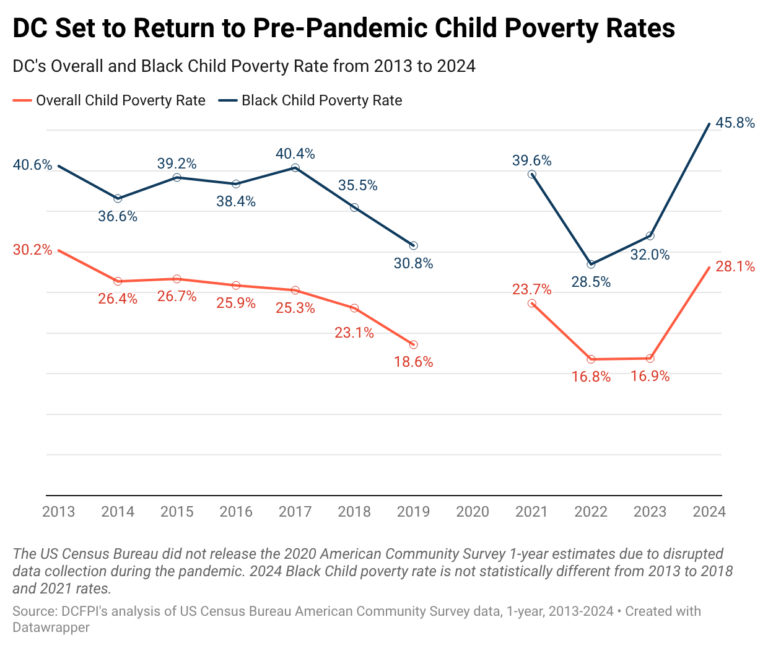 FIGURE 1.
The Truncated Timeline for the TANF Working Group Limits Fair Evaluation of the Cuts
DCFPI would like to express our appreciation for DHS’s commitment to convening the TANF working group and for inviting us to participate. While we greatly value the opportunity for us and other stakeholders to engage, we have serious concerns about the body’s limited scope and truncated timeline to produce recommendations.
The scope of the working group is far too limited. Rather than using this forum to fully examine all three approved TANF changes, DHS has narrowed the focus of the working group to develop a hardship exemption policy that would allow some households to continue receiving benefits beyond 60 months.[6] This approach treats the time limit as a foregone conclusion and effectively excludes any meaningful discussion of sanctions and COLAs. This is deeply concerning given clear evidence that time limits are harmful, and because they would apply to families who have lived through two recessionary periods (the pandemic-induced recession and the one that DC is now entering due to the harm of federal policies).[7],[8] This approach also suggests that DHS may have crafted the working group with key decisions already made, leaving little room for genuine debate, evidence-based assessment, or reconsideration of the TANF cuts entirely.
Beyond scope, the truncated timeline of the working group is also deeply concerning. Although the working group was initially slated to convene last fall, DHS scheduled the first meeting this week. This delay eliminated any opportunity for the group’s work to seriously inform the mayor’s budget decisions, which are typically finalized in early March, after the February revenue forecast and before “pencil’s down.” Furthermore, with only three meetings, each just three hours long, there is simply not enough time to meaningfully examine and deliberate changes of the magnitude scheduled for FY 2027.
Given these concerns, we implore the Committee—particularly members participating in the working group—to ensure the working group discussions fully address all three TANF changes and do not treat the time limit as a settled decision. We further urge the Committee to require DHS to make the working group’s final report publicly available. Lastly, the Committee should articulate to stakeholders how it intends to use the working group’s recommendations in its budget deliberations.
TEP Is Not Effectively Improving Employment Outcomes
The primary employment service DHS offers to TANF families is the TANF Employment and Education Program (TEP), which provides parents with coaching toward education and employment goals. DCFPI commends DHS for its ongoing efforts to improve TEP, including the program’s redesign in October 2024. This relaunch introduced several structural changes intended to improve service delivery, including the Family Choice Model, which allows participants to pursue a self-directed pathway; the integration of job placement and education services under a single vendor; incentive payments tied to two-generation (2Gen) milestones; and streamlined verification requirements.[9]
Despite these changes, both quantitative and qualitative evidence suggest that TEP is still not functioning effectively in terms of helping parents secure long-term, stable employment.
In FY 2025, TEP had an average of just ten job placements for every 1,000 work-eligible TANF recipients—well below DHS’s alarmingly low target of 18 placements.[10] This represents virtually no improvement from FY 2024, when the placement rate was just 11 per 1,000 participants.[11] DHS attributes these poor outcomes to several systemic factors:
- Skills mismatch: Considering their existing skill sets and work histories, most TEP participants struggle to meet the qualifications that employers demand.
- Reduced local hiring: Budget constraints have reduced local hiring in industries that historically employed the largest share of TEP participants, such as hospitality and administrative roles.
- Limited case management: Budget constraints have reduced the number of TEP vendors, resulting in fewer TEP participants receiving case management.
- Staff turnover: The new TEP contract implemented in October 2024 triggered widespread turnover among vendor staff, forcing vendors to hire and train new employees—many of whom lack prior workforce development experience.[12]
Meanwhile, findings from DCFPI’s focus groups with mothers receiving TANF point to additional shortcomings in TEP’s design and implementation that likely contribute to these persistently low placement rates.
Firstly, focus group participants report that TEP does not support “career-ladder promotion.” Instead of advancing participants toward higher-quality, sustainable employment, participants highlighted the limited jobs available through TEP and the misalignment between those opportunities and their career aspirations. One participant described, “It just seems like the same five opportunities, no matter what vendor you’re in.”
Though TEP vendors cultivate employer networkers spanning a wide range of industries, vendors connect participants to jobs by their existing skill sets and work histories rather than career goals.[13] As a result, focus group participants without higher education—a reality for most DC TANF recipients—described being steered into low-wage, undesirable work, such as hospitality or security roles.[14] While this approach may enable participants to find jobs more quickly, placing them into work that doesn’t align with their interests or aspirations is unlikely to lead to lasting self-sufficiency, a purported goal of TEP and TANF. One participant touched on this, explaining, “You have to care about what you’re doing, you know. I think that goes [into] the difference between career readiness and work readiness.”
Secondly, focus group participants expressed deep frustration with how difficult it was to translate TEP participation into actual employment. Because TEP is not a job guarantee program, participants must still navigate the full job application process—a process that does not always result in actual offers, they explained.
Even more discouraging for participants was the amount of time and energy they invested in skill-building activities that failed to lead to concrete opportunities. Participants described attending trainings and classes through their vendor yet feeling that these efforts existed in isolation rather than as part of a coordinated pathway toward their career goals. One participant who took entrepreneurship courses shared that, after finishing the program, “There [was] no real setup for success… and there wasn’t necessarily a pipeline in order to be able to become a business owner.” Although she had access to a case manager, she reported still lacking “the necessary connected resources… to go from one stage to the next stage.”
Multiple participants emphasized that they were not asking for their vendor to “hold their hand,” but they did report needing additional help once courses ended to actually move toward their goals. Some described needing clearer information on next steps of the job search, while others desired financial assistance to cover professional licensing fees, child care, transportation, and other necessities required to secure and sustain employment. Without adequate and tailored supports, participants reported that program activities felt fragmented rather than truly transformative.
Council Should Interrogate TEP’s Effectiveness
Ultimately, the evidence suggests that TEP’s poor outcomes are not the result of participants’ lack of effort, but of longstanding structural barriers that cannot be resolved by using sticks to “compel” people to work. Because TEP is the primary employment resource available to TANF recipients, DCFPI urges the Committee to closely scrutinize the program’s effectiveness before sanctioning parents who are unable to secure stable employment.
Specifically, the Committee should use its oversight authority to require DHS to conduct a formal evaluation of the TEP relaunch. Given the relaunch date was recent, DHS has yet to conduct a full-scale assessment of how the newly-implemented changes are faring in practice. Before holding TANF families accountable through stricter sanctions or time limits, DHS must conduct a full-scale evaluation, engaging TEP participants, vendors, and staff to understand how the updates are actually performing. This assessment should examine:
- The experiences and outcomes of participants pursuing the self-directed pathway.
- Participants’ perspectives on incentive milestones and whether completing them meaningfully improves employment outcomes.
- How vendors providing both employment and occupational training and job placement services are performing under new contracts.
- Whether simplified verification requirements are effectively reducing administrative burdens for participants and vendors.
Additionally, the Committee should urge DHS to conduct rigorous quality control across all TANF vendors to ensure consistent, high-performing service delivery. Vendor performance should be regularly monitored, publicly reported, and tied to corrective action or contract renewal decisions.
Finally, the Committee should work with DHS to improve data collection on work outcomes for TEP participants, even after they exit TANF. Currently, DHS does not track this data, including the percent of people employed upon leaving TANF.[15] DHS should collect and analyze data on employment, earnings, and job stability for individuals who participate in TEP, and ensure this information is publicly available. This will provide a more comprehensive understanding of which policies and services may be leading to long-term career stability and upward mobility.
Improved data collection is critical to grounding policy decisions in evidence. A wealth of research from other states shows that punitive policies, such as time limits and sanctions, increase hardship without improving employment outcomes.[16] Specifically, employment gains among recipients subject to work requirements are modest and often temporary.[17] The vast majority of individuals subject to these requirements remain poor, and some actually became poorer.[18]
DHS Is Not Doing Enough to Connect TANF Parents to Needed Supports
Barriers to employment do not simply disappear because lawmakers impose time limits or sanctions—or even because a parent participates in TEP. Although DHS offers resources intended to address certain obstacles, far too little families are actually connected to the support they need.
Shortage of Non-Traditional Child Care Options Limits Use of Vouchers
For instance, consider access to child care. DHS materials for TANF families repeatedly state that the agency will help parents secure child care when it poses a barrier to work.[19] Nevertheless, in DCFPI’s focus groups with mothers receiving TANF, child care emerged as the single most frequently cited obstacle to employment. Given their low incomes, all participants were likely eligible for child care subsidies. However, several mothers reported that they did not have a child care voucher at all, suggesting the failure of agency staff and vendor caseworkers to identify needs and connect families to the support they’re entitled to receive.
Even so, having a child care voucher does not guarantee access to high-quality care. Multiple participants explained that the jobs accessible to them rarely align with typical child care hours. Evening shifts, on-call work, and unpredictable schedules make it extremely difficult to arrange consistent care for their children. DHS has acknowledged this issue in its FY 2024 Performance Accountability Report, stating that the “the need for non-traditional child care spaces is greater than the available slots.”[20] While DHS offers some supports intended to help families secure child care during non-traditional hours, participants’ ongoing struggles once again suggest that DHS and vendors are not effectively identifying needs, connecting families to available resources, or offering services at a scale large enough to meet the level of need.
Importantly, the gap between demand and supply is likely to worsen for families receiving TANF if the District enacts a child care subsidy waitlist.[21]
Ineffective Screening and Referrals Limit Reach of POWER
DHS’s shortcomings are also evident in how the agency supports TANF recipients experiencing physical and/or mental health challenges, as reported by focus group participants. Multiple parents in DCFPI’s focus groups reported living with mental health conditions such as depression, anxiety, and PTSD, often rooted in past experiences of trauma, including domestic violence and gun violence. Others described having disabilities themselves—such as learning disabilities and epilepsy—or caring for children with disabilities, such as autism. For many participants, managing their own health while meeting their families’ needs is already demanding, making consistent employment difficult to sustain.
Many of these participants likely qualify for the Program on Work Employment and Responsibility (POWER), which exempts TANF recipients with disabilities from work participation requirements and pauses their TANF time limit. However, several participants reported that they were unfamiliar with POWER altogether. While others did not explicitly state whether they were enrolled, the fact that they were still actively searching for work strongly suggests that many were not participating in the program. This points to significant gaps in outreach, awareness, and access to POWER for eligible families.
Only 143 families are currently enrolled in POWER.[22] Given the high prevalence of health conditions and disability among TANF recipients, this low enrollment suggests that many eligible families are not accessing the program.[23] One potential barrier is that families cannot apply to POWER directly; they must be referred.[24] Although DHS is legally required to screen for POWER eligibility at application and recertification, focus group participants repeatedly described challenges communicating with and receiving information from DHS staff. Additionally, documentation requirements can create further barriers, given the difficulty of securing formal diagnoses and substantiating less visible experiences such as domestic violence.
DCFPI commends DHS for having resources in place intended to address key barriers to employment. However, when TANF recipients are not actually accessing these resources—whether because they are unaware they exist or because supports are insufficient in scale—they are not functioning as intended.
We recommend that the Committee encourage stronger cross-agency collaboration between DHS and OSSE to expand access to non-traditional child care options. In addition, the Committee and DHS should firmly oppose the implementation of a child care subsidy waitlist, as proposed by OSSE, which would further restrict access to care and undermine parents’ ability to work.[25]
At the same time, DHS and vendor caseworkers should do more to consistently identify TANF recipients’ needs and connect them to the support they are eligible to receive. DCFPI focus group results suggest that families are falling through the cracks. Assessing the scope of and addressing this failure will require clearer, more formalized processes, but also meaningful investments in staff training.[26]
Notably, disrespectful and dismissive behavior from caseworkers emerged as the single most frequently reported concern and generated the most passionate discussion across focus groups. Participants characterized caseworkers as “rude” and “nasty.” Many felt that staff “don’t want to help,” “give attitude,” and “act like they don’t even want to be at work,” all while behaving as though they are “so much better” than the people they’re serving. These interactions take a significant emotional toll on participants, and they have come to associate DHS service centers as places where they must endure dehumanizing treatment to receive support. Research on administrative burden consistently shows that stigmatizing public service systems deter participation and undermine service delivery.[27] It is therefore unsurprising that participants reported that these hostile interactions with caseworkers were ineffective at connecting them to the supports they need.
We urge the Committee to also work with DHS to mandate trauma-informed training for all agency staff. Trauma-informed training would better enable staff to respond appropriately to participants’ needs, reduce conflict, and foster respectful, supportive service delivery.[28]
The DC Council Must Work With DHS to Protect and Improve TANF
This testimony highlighted key administrative reforms that the Council can spearhead with DHS to improve participants’ experiences on TANF and better address the barriers that limit pathways off assistance. Although these proposed reforms may improve DC’s TANF program, it is critical to emphasize that they are not a substitute for reversing the TANF cuts. DHS can and should improve employment services and address barriers to work, but those efforts will not be effective if a family is going from $800 a month to merely $150. To protect thousands of families with children from losing vital support, the DC Council must reverse all three cuts to TANF.
Thank you for the opportunity to testify. I look forward to discussing these recommendations with you further.
- Urban Institute, “The American Affordability Tracker,” accessed February 2026.
- Connor Zielinski, “DC Child Poverty Back to Extreme Level After Short-Lived Progress,” DC Fiscal Policy Institute, February 2026.
- Ibid.
- Michael McLaughlin and Mark R. Rank, “Estimating the Economic Cost of Childhood Poverty in the United States,” Social Work Research, March 2018.
- Ibid.
- DC Department of Human Services, “TANF Program Update,” accessed February 2026.
- Tazra Mitchell, LaDonna Pavetti, and Yixuan Huang, “Life After TANF in Kansas: For Most, Unsteady Work and Earnings Below Half the Poverty Line,” Center on Budget and Policy Priorities, February 2018.
- Tazra Mitchell and Anne Gunderson, “DC Revenue Higher than Expected, But a Recession Still Looms,” DC Fiscal Policy Institute, October 2025.
- DC Department of Human Services, “TANF Employment and Education Program (TEP) Redesign,” accessed February 2026.
- DC Department of Human Services, “FY 2025 Performance Accountability Report,” January 2026.
- DC Department of Human Services, “FY 2024 Performance Accountability Report,” January 2025.
- DC Department of Human Services, “FY 2025 Performance Accountability Report,” January 2026.
- DCFPI meeting with DC Department of Human Services on January 9, 2026.
- Presentation delivered by DC Department of Human Services during TANF Working Group Meeting on February 25, 2026.
- Council of the District of Columbia, “DHS Responses to Pre-FY25 POH Questions,” February 2026.
- LaDonna Pavetti, “TANF Studies Show Work Requirement Proposals for Other Programs Would Harm Millions, Do Little to Increase Work,” Center on Budget and Policy Priorities, November 2018.
- LaDonna Pavetti, “Work Requirements Don’t Cut Poverty, Evidence Shows,” Center on Budget and Policy Priorities, June 2016.
- Ibid.
- DC Department of Human Services, “Temporary Assistance for Needy Families (TANF): Your Guide to Putting The Pieces Together,” accessed February 2026.
- DC Department of Human Services, “FY 2024 Performance Accountability Report.”
- Anne Gunderson, “Proposed Child Care Subsidy Waitlist Could Leave District Parents and Providers Paying the Price,” DC Fiscal Policy Institute, February 2026.
- Council of the District of Columbia, “DHS Responses to Pre-FY25 POH Questions,” February 2026.
- Ali Sawawi and LaDonna Pavetti, “Most Parents Leaving TANF Work, But in Low-Paying, Unstable Jobs, Recent Studies Find,” Center on Budget and Policy Priorities, November 2020.
- Jennifer Mezey, “POWER/Exemption Analysis of TANF time limit provisions in BSA as adopted in July 2025.”
- Anne Gunderson, “Proposed Child Care Subsidy Waitlist Could Leave District Parents and Providers Paying the Price,” DC Fiscal Policy Institute, February 2026.
- DCFPI did not speak to caseworkers during our focus groups; hearing from them directly could provide ideas for improvement.
- Pamela Herd and Donald Moynihan, “Administrative Burden: Policymaking by Other Means,” 2018.
- Buffalo Center for Social Research, “What is Trauma-Informed Care?,” accessed February 2026.