


Chairman Mendelson, members of the committee, thank you for the opportunity to testify. My name is Anne Gunderson, and I am a Senior Policy Analyst at the DC Fiscal Policy Institute (DCFPI) and a member of the Under 3 DC Coalition (U3DC). DCFPI is a non-profit organization that shapes racially-just tax, budget, and policy decisions by centering Black and brown communities in our research and analysis, community partnerships, and advocacy efforts to advance an antiracist, equitable future.
My testimony focuses on core programs that support the early childhood system and allow every family in DC to have access to high-quality, affordable care for their children, including the Pay Equity Fund (PEF) and the child care subsidy program. Together, these programs ensure that DC is recruiting and retaining dedicated, credentialed educators to work in classrooms that are supported by local funding to help offset the cost of child care for families with young children.
While these programs are working well to provide quality, affordable care and delivering great benefits to DC’s economy, the recent reduction to the salary minimums for early educators is diminishing some of the progress the District has built toward equipping the early childhood industry with highly-qualified educators.[1] Additionally, Mayor Bowser has proposed changes to the child care subsidy program to reduce costs by introducing a waitlist that would limit the number of families who can be served by the program and cutting the rates that providers are paid to serve these families.[2]
Further cuts to PEF and programmatic changes to the subsidy program that the mayor recently proposed would harm the broader early education ecosystem by reducing wages for educators, driving up operational costs to providers, and restricting the availability of affordable child care options. This will make child care even less affordable for District families than it already is. These cuts would also undermine efforts in the mayor’s growth agenda, given that child care businesses make all other work possible. To continue making progress toward a high-quality, accessible, and affordable early childhood education system in DC, the Office of State Superintendent (OSSE) and lawmakers should:
- Work closely with directors, educators, and advocates to develop solutions for stabilizing costs to the PEF and the child care subsidy program instead of advancing deep cuts to these programs;
- Effectively communicate proposed policy changes to child care providers so they can prepare their staff and budgets to absorb these changes; and,
- Conduct caseload projections and present accurate cost projections for the child care subsidy program so that lawmakers can adequately budget for increasing program costs.
The Pay Equity Fund and Child Care Subsidy Program Support Families and Facilities in Every Ward
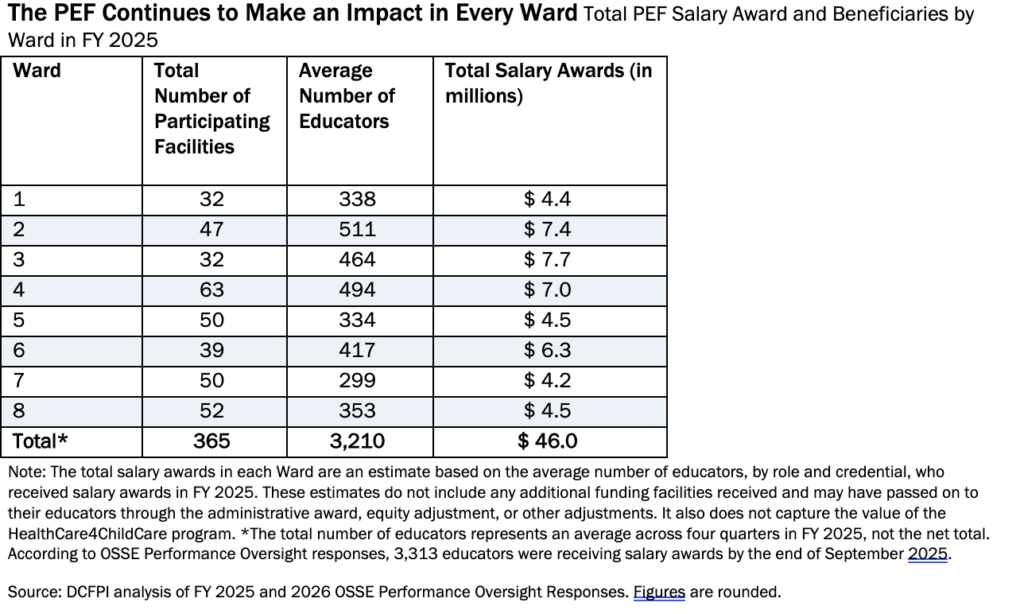
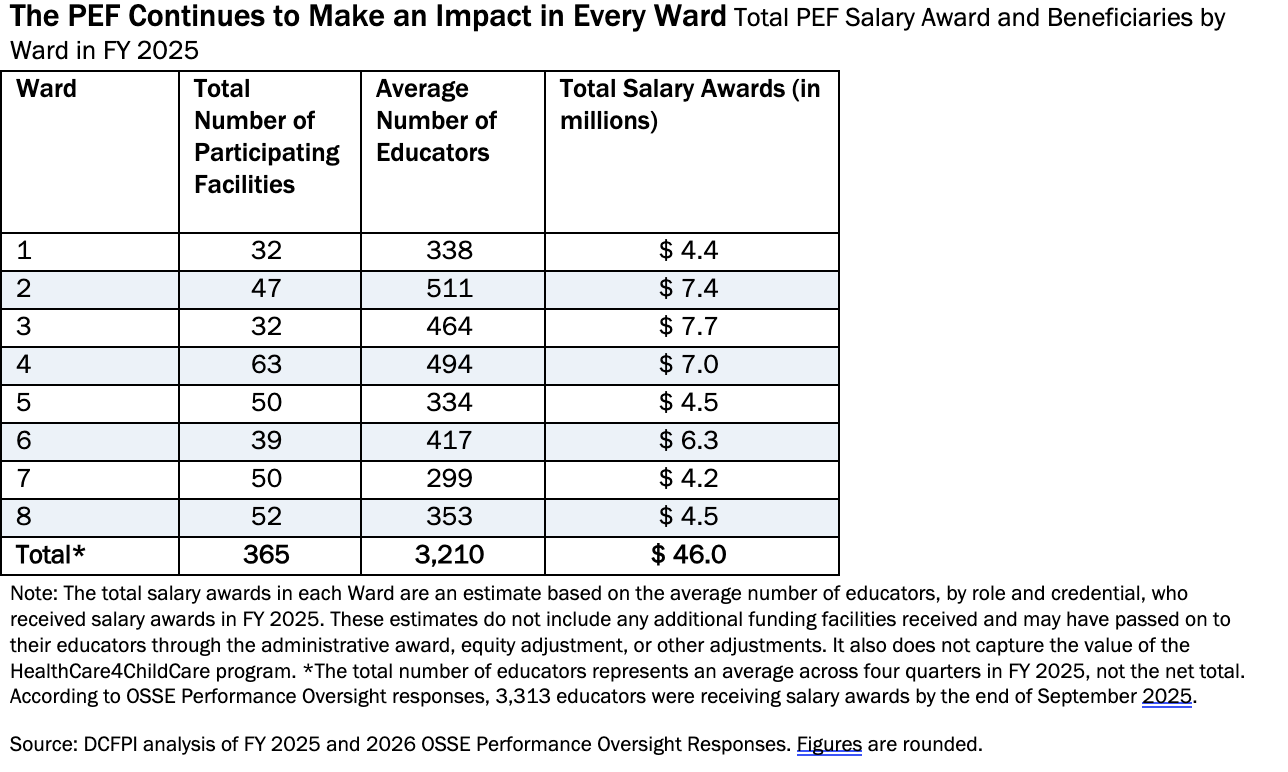
DCFPI commends OSSE and DC Health Benefit Exchange (HBX) for making bold progress on fair compensation for more than 3,300 early educators, most of whom are Black and brown women, through the implementation of the PEF in fiscal year (FY) 2025.[3] OSSE distributed more than $63 million directly to 364 child development facilities (CDFs) that fiscal year. This total includes benefits beyond the salary awards, such as additional funds to administer the program and enhancements for facilities that serve families using child care subsidies, facilities that serve infants and toddlers, and home-based facilities. Of the $63 million, an average of $46 million went directly towards salary awards for educators employed at facilities in every ward in FY 2025, benefitting educators in Wards 2, 3, and 4 the most (Table 1).Participating facilities are also eligible for HealthCare4ChildCare (HC4CC), which makes free or low-cost health care coverage available to child care workers whose employers purchase subsidized coverage through the DC Health Benefit Exchange.
TABLE 1.
PEF is Reaching Fewer Educators and Causing Harm to Some Facilities Following FY 2025 Program Changes
Prior to FY 2025 and in response to budget constraints, the Council reconvened the Early Childhood Educator Equitable Compensation Task Force to redesign the funding formula and make other programmatic changes to reduce costs and more equitably distribute available funding across CDFs. The Task Force recommended, and OSSE implemented, disqualifying educators without early childhood degrees or credentials from receiving salary awards. This change meant reducing the number of educators receiving awards from 3,617 at the end of FY 2024 to 3,104 at the start of FY 2025.[4] All participating facilities received further reductions to their awards due to the other changes to the formula, including removing the temporary 30 percent supplemental enhancement that all facilities received in FY 2024 and reducing the administrative enhancement from 15 percent of the base award to 12 percent. Some of these losses were offset by new equity enhancements, such as increasing the enhancement to subsidy providers and including new enhancements for child development homes and facilities serving infants and toddlers.[5]
Some CDFs managed to maintain the minimum salaries in law by relying more heavily on philanthropic contributions while others were forced to increase tuition rates on families to close the gap.[6] When the Council passed lower salary minimums to take effect on January 1, 2026, OSSE reduced facility awards accordingly, and every participating facility received a substantial reduction to their awards in December 2025. . This time, facilities are having a harder time closing the gap and some have been forced to reduce the salaries of their teachers or risk operating at a loss, according to reports to the U3DC from directors of CDFs. At a time when the cost of living continues to rise, lawmakers should ensure that salaries are keeping pace with inflation, not reducing them. Many educators have anecdotally reported to U3DC they are experiencing greater stress and anxiety about making ends meet because of this cut.
The Subsidy Program Reaches All Wards But is Now Under Serious Threat
OSSE served more than 7,200 children through the child care subsidy program by the end of FY 2025, exceeding the year-end total in FY 2024 by 1,640 children.[7] Program changes have likely caused utilization to increase substantially from FY 2024 to FY 2025, including expanding eligibility to families at or below 300 percent of the federal poverty line, putting the subsidy application online, removing certain work requirements, and simplifying eligibility for families receiving Temporary Assistant for Needy Families (TANF).[8] Enrollment continues to trend upward in FY 2026—October and November enrollment remains above 7,000 children per month, representing a 21 to 22 percent growth rate over enrollment from that same period in FY 2025 and nearly a 40 percent growth rate compared to FY 2024.[9]
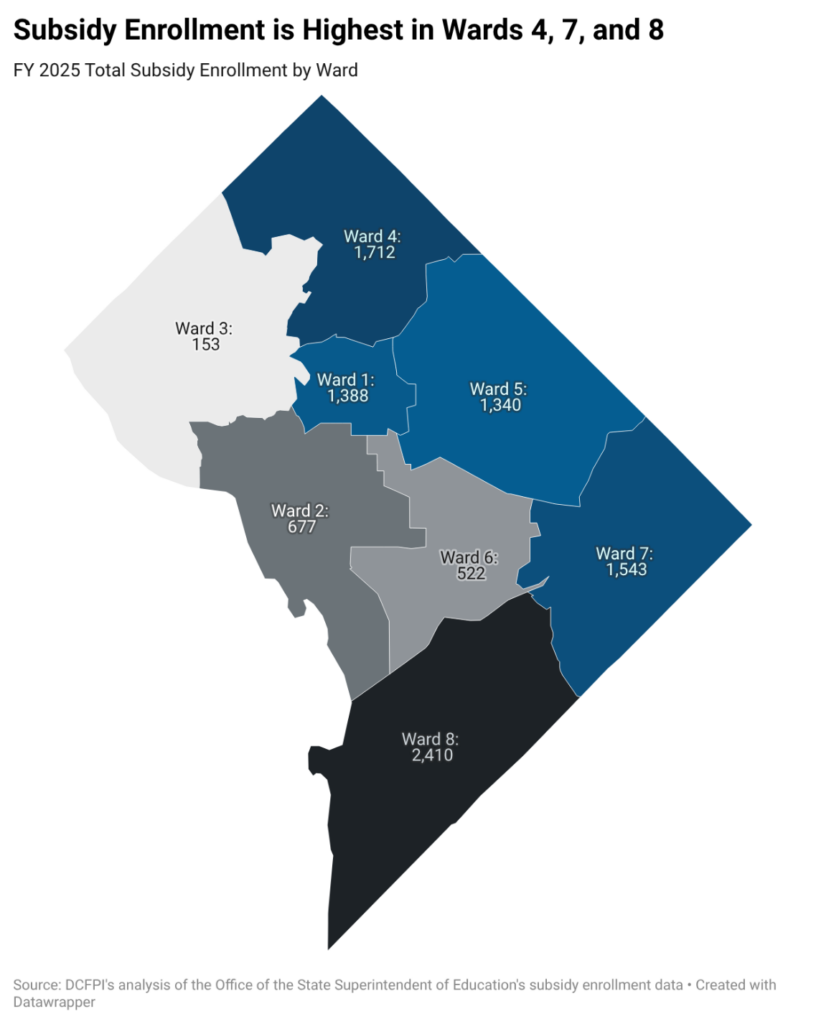
Families in every ward make use of the child care subsidy program to offset the astronomical costs of child care in the District, with enrollment rates the highest in Wards 4, 7, and 8 (Figure 1). DC has the highest costs for child care compared to the rest of the country, with families paying more than $23,000, on average, per year to enroll their children in infant care.[10] And much like the cost of everything else, the cost of providing care continues to increase, making this program increasingly important for more and more District families.
Figure 1.
Advocates have been working with OSSE for years to push for improvements to the program to increase utilization among eligible families, so under normal circumstances, this progress would be celebrated. However, DC lawmakers underfunded this program, which is now facing a dire budget shortfall in FY 2026. To curb costs, Mayor Bowser proposed a series of harmful policy changes, including reducing reimbursement rates to subsidy providers and instituting a waitlist for new families seeking entry into the program.[11] While these changes would reduce costs, it would also be detrimental to the District’s early childhood system.
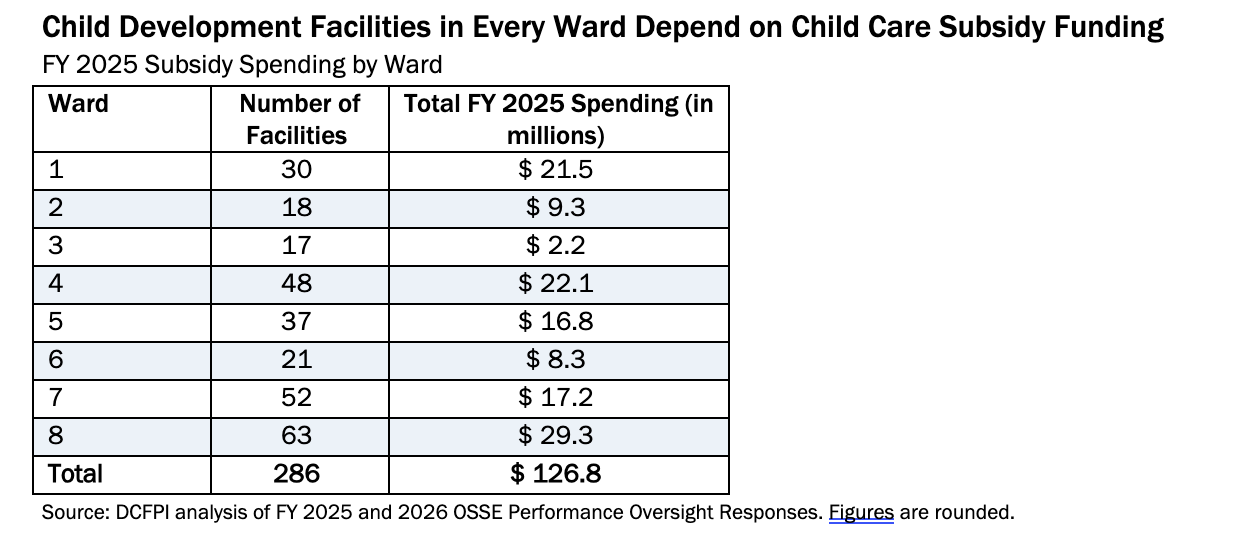
By reducing reimbursement rates, existing subsidy providers will struggle to keep up with the growing operating costs and may need to close classrooms or raise tuition for private-pay families to prevent closures. This may cause some CDFs to stop accepting child care subsidies and further disincentive non-subsidy providers from participating.[12] Fewer classrooms and CDF closures will shrink supply, which DC cannot afford because demand for child care already outpaces supply.[13] Cutting reimbursement rates will exacerbate this problem because it reduces the funding the government contributes towards care and shifts that cost to CDFs and, ultimately, families, causing tuition to increase. More than half of CDFs across the District accept child care subsidies, so this reduction would hurt providers in every ward (Table 2).
TABLE 2.
The purpose of the waitlist would be to reduce overall spending on the program, which means that OSSE would freeze new enrollment. And as existing families using subsidies matriculate out, OSSE would prohibit new families from accessing a subsidy until overall enrollment in the program drops to levels that can be funded at the level set by District lawmakers. Not only would this cause significant losses to subsidy providers who would not be able to fill subsidy seats until the waitlist opened up, but it would also put access to this critical financial support out of reach for any new families who need it.
When families cannot access affordable child care, they are forced to forgo work or educational opportunities in order to care for their children at home, they lose out on earnings and spend less, which means less money flowing to DC businesses and lower tax revenue. Moreover, children need high-quality, supportive environments to develop social and emotional skills and to build foundations for future learning.[14] Making it harder to access child care subsidies makes it more difficult for children from low- and moderate-income families to thrive, and for the youngest children, to show up ready to learn by kindergarten.
Improvements OSSE Can Make to be More Responsive to Community
Allow Early Childhood Stakeholders to Drive Solutions
If lawmakers are unwilling to fully fund the PEF and the child care subsidy program, OSSE should convene early childhood system stakeholders to inform any necessary programmatic changes to reduce costs. The Early Childhood Educator Equitable Compensation Task Force, made up of child care owners, experts, and advocates, is an excellent example of how important decisions should be made. When lawmakers convened the Task Force in 2024, members took a thoughtful approach to reducing costs and reallocating funds to ensure greater equity in the face of painful cuts. More cuts were necessary to limit PEF spending to approved 2025 budgeted levels, but instead of reconvening the Task Force, the Council moved ahead to reduce salary minimums and pushed the field further away from pay parity with DC Public School teachers, undermining the central purpose of the PEF.
Mayor Bowser’s recommendations for containing child care subsidy costs are similarly deeply harmful and inequitable. Under the mayor’s proposed policy change, all subsidy providers would receive the lowest reimbursement rates that are currently reserved for facilities at the lowest quality level. Therefore, high-quality child care subsidy providers, especially those who primarily serve families using subsidies, would take the biggest hit. In DC, there are high-quality providers whose centers serve 90 to 100 percent subsidy families who reported that they use their enhanced reimbursement rates to hire specialized support staff who cater to the needs of children with developmental delays.[15] Reducing their reimbursement rates, especially if combined with a subsidy enrollment freeze, would likely mean laying off that support staff and possibly lead and assistant teachers. This underscores that the first people who would be harmed if policymakers put early education cuts into place are the families with the highest needs and the providers who care for them.
When families, providers, educators, and advocates are not at the table to guide these decisions, inequitable policies can go unchecked and threaten the wellbeing of the most vulnerable. The Council should require OSSE to create formal procedures to allow the early childhood community to inform the policies that directly impact them.
Effectively Communicate Policy Changes to the Community
When policy changes happen, whether led by OSSE or by lawmakers, OSSE should make more of an effort to clearly communicate those changes and potential impacts to providers, educators, and families. OSSE offers monthly stakeholders calls and one-on-one support to providers via regular office hours, but these tools have not been effectively leveraged to communicate important changes to providers. For example, when the Council passed legislation to reduce salary minimums for PEF participants, the law stated that those lower salaries would go into effect on January 1, 2026. However, it was not clear to providers when their facility awards would be reduced to reflect that change. When OSSE reduced every facility’s award in December 2025, many providers were caught off guard and were unprepared to take such a substantial cut to their budgets, as reported to U3DC. If OSSE allowed attendees to speak with them and have a dialogue during the monthly stakeholders meetings, providers could have sought clarification and this confusion could have been avoided.
Another example was in August 2025, when OSSE published a draft waitlist policy for the child care subsidy program and asked stakeholders for feedback before September. Advocates rushed to get the information to providers, document their feedback, and push for changes to the policy within a week of OSSE publishing it, but OSSE never discussed the waitlist publicly after that. Instead, providers were left in the dark for months, anticipating a waitlist that could be deeply detrimental to their operations, with no update at all from OSSE. While the decision to implement a waitlist does not solely rest on OSSE, they are responsible for the effective implementation of the subsidy program and ought to take responsibility for communicating with providers and providing regular updates. Members of this committee should be demanding more transparency and timely updates from the Bowser Administration.
Require OSSE to Publish Caseload and Cost Projections for the Child Care Subsidy Program
OSSE has increased early education data transparency by offering quarterly updates on the spending and reach of the PEF, allowing advocates to use the information to keep DC Council informed on spending and to offer recommendations to curb costs. However, OSSE fails to provide similar information on the child care subsidy program despite making many promises to offer quarterly updates to U3DC and the broader early childhood community. This lack of transparency has left stakeholders in the dark, making it more difficult to provide feedback and recommendations for improving the program and forcing CDF directors to adjust their budgets and operations mid-year to respond to cuts. Greater budget and spending transparency would allow expert stakeholders, including CDF directors, to help OSSE make necessary adjustments to the program while minimizing harm to CDFs and the families they serve.
This Council made progress towards unpacking the available funding and projected spending for the child care subsidy program, but questions remain. OSSE claims that they are unable to do caseload projections for this program despite other states, such as Virginia, Colorado, Wisconsin, and Massachusetts successfully projecting caseloads for their child care subsidy program and despite DC regularly projecting enrollment for K-12 schools.[16] Without caseload projections, OSSE runs the risk of falling short of the funding they need to support every parent who seeks access to a subsidy. A standalone education committee within the Council could help push OSSE to provide accurate caseload and cost projections by dedicating additional staff capacity to assist and ensuring accountability to lawmakers.
Thank you for the opportunity to testify. I look forward to discussing these recommendations with you further.
- DC Act 26-196: Early Childhood Educator Pay Scales Emergency Amendment Act of 2025.
- Executive Office of the Mayor, Presentation to the DC Council, Mayor-Council Breakfast, February 10, 2026.
- DC Office of the State Superintendent of Education, “Responses to Fiscal Year 2025 and 2026 Performance Oversight Questions,” February 2026.
- DC Office of the State Superintendent of Education, “Responses to Fiscal Year 2024 Performance Oversight Questions,” February 2025.
- Early Childhood Educator Equitable Compensation Task Force, “Report of the Early Childhood Educator Equitable Compensation Task Force,” Submitted to the Mayor and Council of the District of Columbia, September 30, 2024.
- In 2026, DC Action and DCFPI have been interviewing CDF directors who primarily serve families using subsidies. In these interviews, many directors stated that they were able to turn to philanthropy to increase funding to close the gap in lost funding from DC. Other centers, like Two Birds in Tenleytown, added a surcharge to their tuition rates in response to the PEF reduction that is still in place today.
- Anne Gunderson, “Proposed Child Care Subsidy Waitlist Could Leave District Parents and Providers Paying the Price,” DC Fiscal Policy Institute, February 20, 2026.
- DC Office of the State Superintendent of Education, “DC Child Care Subsidy Program Policy Manual,” October 2024.
- DCFPI analysis of monthly spending data from Andrew Gall, Deputy Chief of Staff, DC Office of the State Superintendent of Education, Email sent to Nora Charles, “Child Care Subsidy Requests,” January 21, 2026.
- Sarah Javaid and Melissa Boteach, “Child Care is Unaffordable in Every State,” National Women’s Law Center, February 2025.
- Executive Office of the Mayor, Presentation to the DC Council, Mayor-Council Breakfast, February 10, 2026.
- Anne Gunderson, “If You Build It: Recommendations for Increasing the Supply of Affordable Child Care to Meet District Demand,” DC Fiscal Policy Institute, February 19, 2025.
- Bainum Family Foundation, “Assessing Child Care Access: Measuring Supply, Demand, Quality, and Shortages in the District of Columbia,” January 2024.
- Jennifer Palmer, “Social and Emotional Development in Early Learning Settings,” National Conference of State Legislatures, October 19, 2019.
- DC Action and DCFPI interviews with CDF directors who primarily serve families using subsidies. This issue was first elevated by Tara Villanueva, Center Director of House of Ruth, and echoed by other center directors in subsequent interviews.
- Virginia Code §22.1-289.03 requires the Department of Education to report projected general funds needed for the next two fiscal years. Colorado forecasted the percent of eligible families who would seek access to a subsidy to estimate the cost of getting rid of their waitlist. Information on Wisconsin and Massachusetts caseload projections from BB Otero, advisor to Under 3 DC, Email sent to Anne Gunderson, February 14, 2026.